
04/03/2026
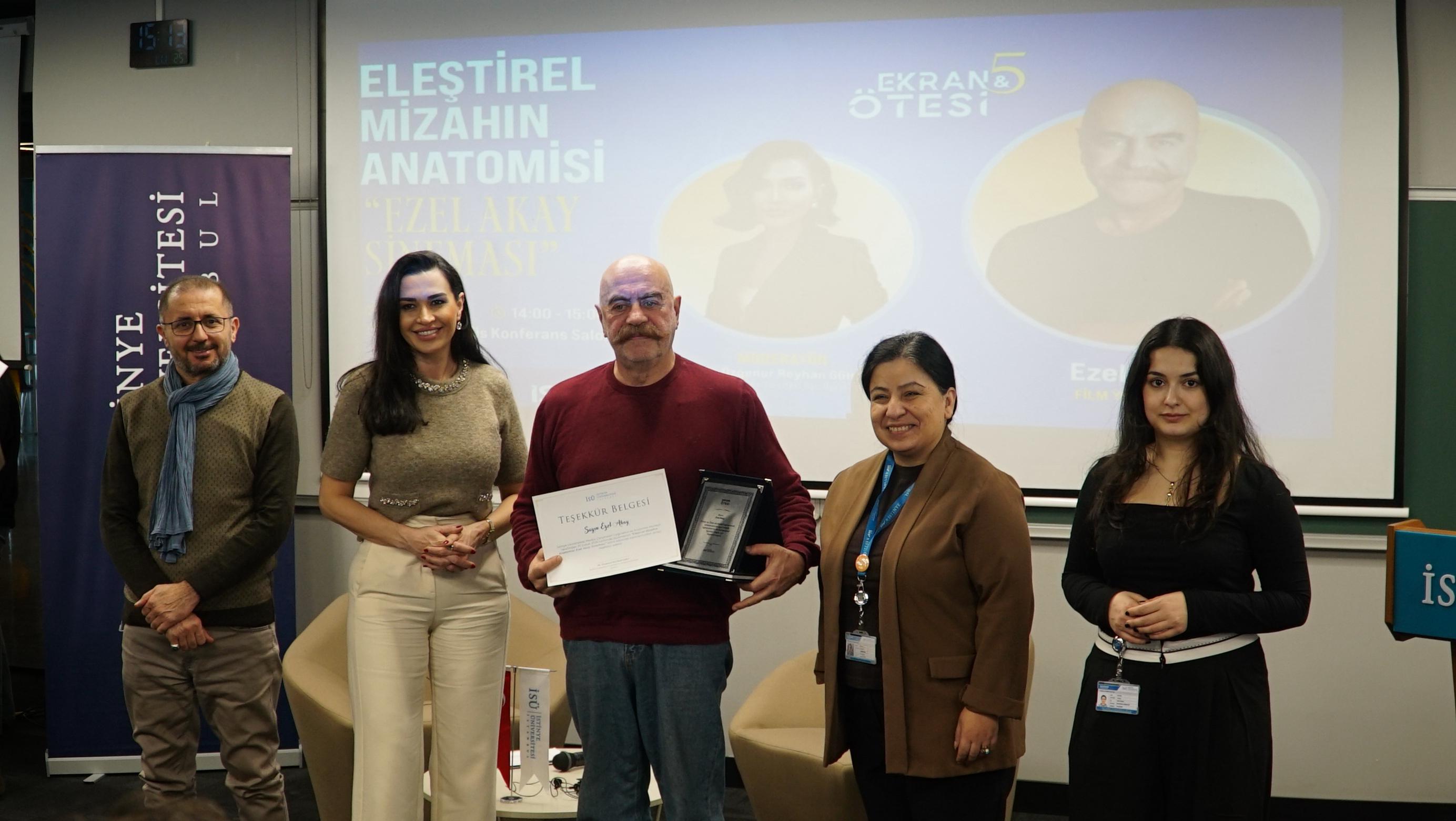
The guest of this week’s episode of the “Ekran ve Ötesi” program, organized by the Media Center of the Faculty of Communication at Istinye University, was Ezel Akay, a prominent figure in Turkish cinema and theater known for his work as a director, screenwriter, and actor.
In the talk titled “The Anatomy of Critical Humor,” Akay shared with the audience his career journey from engineering to directing, how he combines cinema with humor, and his perspective on storytelling.
Known for his work in many notable productions such as Where’s Firuze? (Neredesin Firuze), Why Was Hacivat Karagöz Killed? (Hacivat Karagöz Neden Öldürüldü?), 7 Husbands for Hurmuz (7 Kocalı Hürmüz), and Ottoman Republic (Osmanlı Cumhuriyeti), Akay also discussed his experiences in acting, his thoughts on film production processes, and his professional background in advertising.
“For me, university was a period of searching for myself.”
Akay stated that he studied engineering at university but felt that the field did not fully define him. For this reason, he joined many university clubs in areas such as theater and music in order to better understand himself and discover his talents. Describing his university years as a period of exploration and self-discovery, Akay emphasized that engaging with different disciplines made significant contributions to his career.
“The real name of my profession is storytelling.”
Akay explained that the essence of working in cinema and theater is storytelling, saying:
“For a storyteller, what matters is not the story itself, but the storyteller. What differentiates people engaged in art is not the stories they tell, but the way they tell them.”
Addressing young people during the talk, Akay emphasized that storytelling and artistic freedom should be prioritized over financial gain.
“Everyone thinks about pleasing the audience.”
“Everyone thinks about pleasing the audience. The idea is to make something commercial and give the audience what they want so that they come to the cinema. But we do not go to the cinema just to find what we already expect. We want to be surprised, to see something new, to encounter something different in the stories being told. The majority of the audience actually feels this way,” Akay said, highlighting the importance of courage and innovation in cinema.
“It is very important for me that a project tells its story while entertaining the audience.”
Akay stated that even if his projects contain painful, tragic, or emotionally intense characters, he prefers to present them in a way that entertains the audience. He emphasized that humor can make even the harshest issues more accessible.
He also noted that his profession is a way of life. According to Akay, cinema and television production require a long-term creative process, which naturally intertwines one’s professional life with one’s personal life.
“If you have the ability to observe, you have already laid the foundation of storytelling.”
Emphasizing the importance of observation in the field, Akay noted that analyzing people, situations, and events forms the basis of storytelling. Offering advice to young people who wish to work in the arts, he concluded his talk with the following words:
“It is very important to ask yourself: ‘Is this a field that suits my talents?’ Everyone has a talent, but what matters is discovering it.”
At the end of the program, Dr. Öğr. Üyesi Özgeur Reyhan Güler from the Media Center presented a certificate of appreciation to Ezel Akay.