
About Hackathon
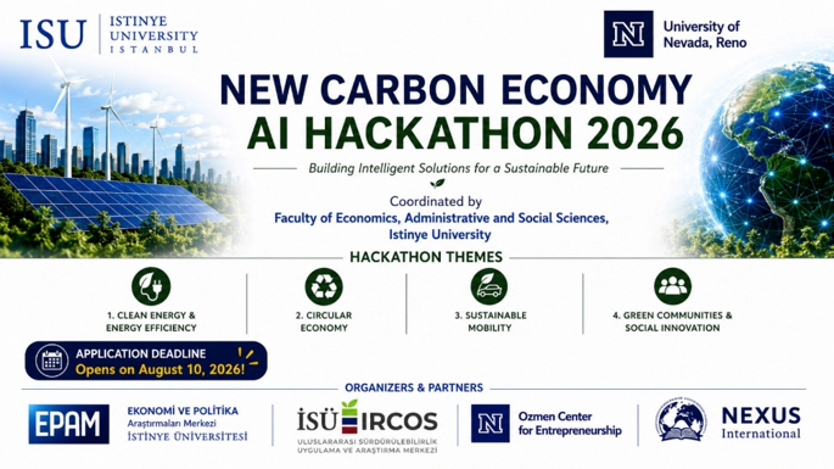
The New Carbon Economy Artificial Intelligence Hackathon is an interdisciplinary innovation competition organized by İstinye University EPAM, IRCOS, NEXUS, and the OZMEN Center–University of Nevada within the framework of the New Carbon Economy Symposium 2026. The hackathon aims to bring together undergraduate students from diverse academic backgrounds to develop innovative artificial intelligence solutions addressing the environmental, economic, and social challenges of the transition to a low-carbon economy. The event seeks to foster innovative ideas aligned with global sustainability priorities and digital transformation while strengthening collaboration among students, researchers, industry representatives, entrepreneurs, local governments, and policymakers.
Will be edit soon
Will be edit soon
Will be edit soon
Will be edit soon
How to Apply & Evaluation
Application & Participation Requirements
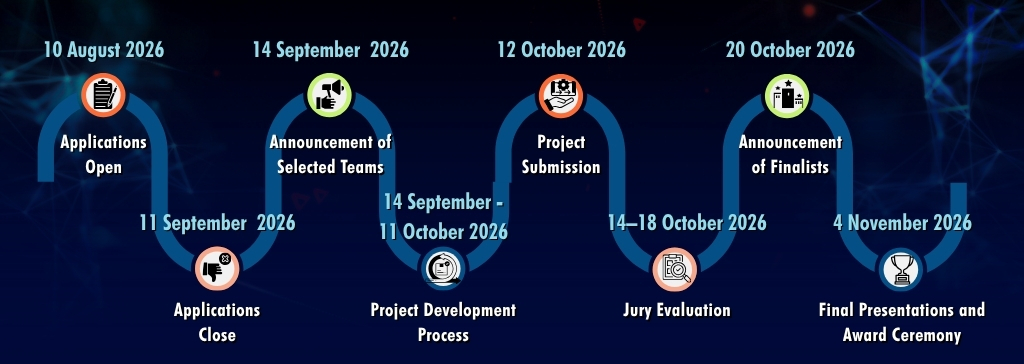
The New Carbon Economy AI Hackathon 2026 is open to undergraduate students, researchers, and interdisciplinary teams interested in developing innovative solutions in the fields of clean energy and energy efficiency, circular economy, sustainable mobility, green communities and social innovation, and the new carbon economy. Applications will be accepted between 10 August and 11 September 2026, and participants are required to apply in teams consisting of 3–5 members.
The hackathon will be conducted entirely online. During the project development and hackathon periods, teams will develop their projects remotely in accordance with the schedule, procedures, and regulations established by the Organizing Committee. All communication, project submissions, and evaluation processes will be carried out through the official digital platforms designated by the organizers.
Participation is subject to the complete submission of the online application form and approval by the Organizing Committee. Incomplete applications or applications that do not comply with the stated requirements may be excluded from the evaluation process. Participation may also be revoked in cases of misconduct, violation of the competition rules, or breach of ethical standards.
All submitted projects must be original and developed specifically for this hackathon. Projects that have been previously published, commercialized, or submitted to other competitions will not be accepted.
The Organizing Committee reserves the right to request additional documentation, verify the eligibility of participants, and make final decisions regarding participation and competition procedures.
Application Procedure
Applications must be submitted through the official online application form.
The following information is required during the application process:
- Team name
- Full names, departments, and universities of all team members
- Contact information of the team leader
- Project title
- Project theme
- Keywords
- A short project abstract (maximum 500 words)
Incomplete applications will not be considered after the application deadline.
Evaluation Process & Judging Criteria
Projects submitted during the main hackathon stage will be evaluated by an academic and professional jury appointed by the Organizing Committee. Each criterion carries equal weight in the final score.
| Evaluation Criterion | Weight |
|---|---|
| Innovation and Creativity | 25% |
| AI Integration | 25% |
| Environmental Impact and Sustainability | 25% |
| Presentation and Communication | 25% |
Innovation and Creativity (25%)
Originality, novelty, and creative value of the proposed solution and its contribution to the new carbon economy.
AI Integration (25%)
Effective and meaningful use of artificial intelligence, machine learning, data analytics, or intelligent systems.
Environmental Impact and Sustainability (25%)
Potential contribution to carbon reduction, resource efficiency, renewable energy adoption, circular economy practices, climate resilience, and sustainable development objectives.
Presentation and Communication (25%)
Clarity, coherence, professionalism, and effectiveness of the project presentation and communication with the jury.
The teams receiving the highest scores will be invited to the final stage.
Final Presentations
Presentation and question-and-answer durations will be announced separately by the Organizing Committee. Teams that do not place in the top three will be granted the opportunity to present their projects at the 3rd Sustainability Symposium to be held in December 2026.